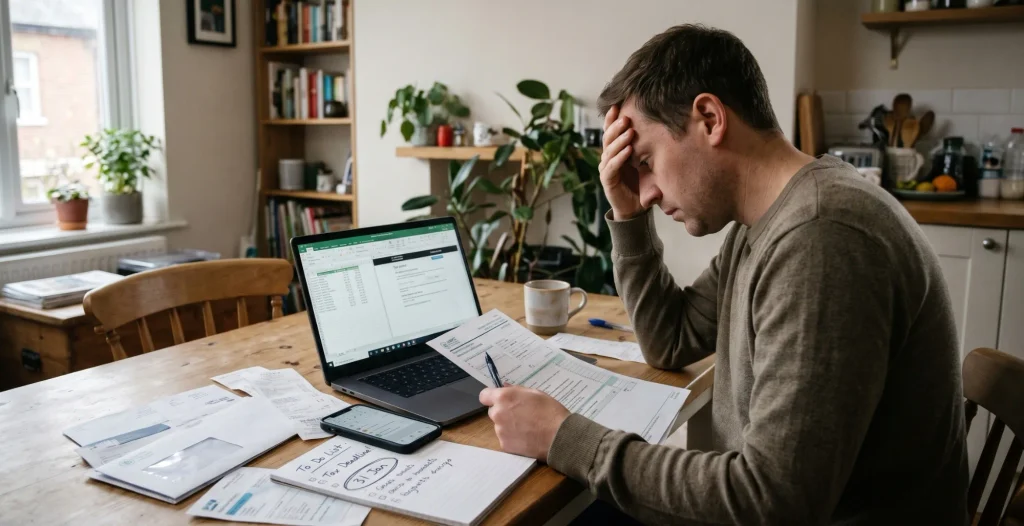
What if one missed date cost you £100 before you had even finished your morning tea? It sounds dramatic, but that is exactly how the self-assessment deadline works.
HMRC doesn’t send a friendly nudge first. The penalty lands the day after 31 January, whether you owe thousands or nothing. Plenty of people get caught out. The good news is that the rules are actually simple once you see them laid out.
This guide walks you through the key dates, penalties, and what to do if the deadline has already passed.
Key Self Assessment Deadline for the 2025/26 Tax Year
The 2025/26 tax year ran from 6 April 2025 to 5 April 2026. Here are the key dates.
| Date | What happens |
| 5 October 2026 | Last day to register for Self Assessment if you’re new to it |
| 31 October 2026 | Deadline for paper returns (this has now passed) |
| 30 December 2026 | Online filing cut-off if you want tax under £3,000 collected through your PAYE tax code |
| 31 January 2027 | Online return deadline, balancing payment due, and first payment on account for 2026/27 |
| 31 July 2027 | Second payment on account for 2026/27 |
Today is 10 November 2026, so the paper deadline has passed. If you file online, you still have until 11:59pm on 31 January 2027. That’s the date most people should have circled.
When Is the Self Assessment Deadline and What Happens If I Miss It?
For most people, the deadline is 31 January 2027 for the 2025/26 tax year. You must pay by the deadline when you submit the return. Early filing does not move the payment deadline up. You could file in May and still make the payment in January. Missing this deadline will incur an automatic fine. There is no reminder letter and no grace period. The penalty will be £100 even if you miss it by just one day.
Late Filing Penalties: How Fast the Cost Adds Up
The £100 is only the start. The longer your return sits unfiled, the bigger the bill gets.
| How late | Penalty |
| 1 day | £100 fixed penalty |
| 3 months | £10 per day for up to 90 days (maximum £900) |
| 6 months | 5% of the tax due or £300, whichever is higher |
| 12 months | Another 5% of the tax due or £300, whichever is higher |
Add those fixed amounts together, and a return that’s a year late can cost you £1,600 before any tax or interest. In serious cases where information has been deliberately held back, the 12-month penalty can be higher.
Late Payment Penalties and Interest
Filing and paying are separate matters. You can file on time and still be fined for paying late.
- 30 days late: 5% of the tax still unpaid
- 6 months late: another 5% of what’s still unpaid
- 12 months late: a further 5%
- Interest: charged daily from the original due date until you’ve paid in full, at HMRC’s current rate (the Bank of England base rate plus 4%)
Here’s a real-feeling example. Say your bill is £4,000 and you file and pay about seven months late.
| Item | Cost |
| Initial late filing penalty | £100 |
| Daily penalties (90 days × £10) | £900 |
| Six-month filing penalty | £300 |
| Late payment at 30 days (5%) | £200 |
| Late payment at 6 months (5%) | £200 |
| Total penalties | £1,700 |
Interest comes on top of that. That’s a lot of money for a delay that could have been avoided.
Payments on Account: The Bit That Surprises People
Many people are caught off guard by this one. If your last Self Assessment bill was over £1,000, and less than 80% of your tax was already collected at source, HMRC asks you to pay in advance toward next year’s bill.
- Each payment on account is half of your previous year’s bill
- The first is due 31 January, alongside your balancing payment
- The second is due 31 July
So if you owe £4,000 on 31 January 2027, you might actually need to send £6,000: the £4,000 balance plus a £2,000 first payment on account. It’s worth budgeting for. If you expect your income to drop, you can apply to reduce these payments.
What About Making Tax Digital?
Since April 2026, self-employed people and landlords with qualifying income above £50,000 have had to follow Making Tax Digital for Income Tax. That means keeping digital records and sending quarterly updates through compatible software. The threshold drops to £30,000 from April 2027 and £20,000 from April 2028. Your 2025/26 return is still due by 31 January 2027, though. Making Tax Digital changes how you report going forward, not this particular deadline.
What to Do If You’ve Already Missed the Self Assessment Deadline?
Don’t panic and don’t hide. Penalties grow with time, so doing something today beats doing nothing for another month.
- File the return straight away: This stops the daily penalties from piling up.
- Pay what you can: Late payment charges and interest apply only to the unpaid balance.
- Contact HMRC if you can’t pay in full: You may be able to set up a Time to Pay arrangement to spread the bill.
- Check your penalty notice: Mistakes happen, and it’s worth confirming the dates and amounts.
- Appeal if you had a good reason: More on that below.
Can You Appeal a Penalty?
Yes, if you had a reasonable excuse. HMRC generally accepts things like a serious illness, a death in the close family, a fire or flood, or a genuine problem with HMRC’s own online systems. You’ll need to explain what happened and show that you filed as soon as the problem was resolved. Forgetting, being busy, or not realizing the date won’t usually count. You must normally make appeals within 30 days of the penalty notice. Keep any evidence you have, such as hospital letters or screenshots of error messages.
Do I Need an Accountant to File My Self Assessment Tax Return?
No, you don’t have to. Plenty of people file their own return online, and it goes perfectly well, especially if their finances are simple. But some situations get complicated quickly. If you have several income streams, rental properties, foreign income, capital gains, or a business with expenses to sort through, a professional can save you both time and money. A good self-employed tax return service will also check that you’re claiming everything you’re entitled to. If you’re weighing up whether to hire an accountant for tax return support, think about what your time is worth and how confident you feel with the figures. Here’s a quick way to decide.
| You might be fine on your own if… | You might want help if… |
| You have one source of income | You have multiple income streams |
| Your expenses are few and clear | You’re unsure what you can claim |
| You’ve filed before without issues | You’re new to self employment |
| Your records are tidy | You’ve already missed a deadline |
Simple Habits That Keep You Ahead of the Deadline
- Set a reminder for early January, not the last week
- Keep receipts and invoices in one place as you go
- Put aside a portion of every payment you receive for tax
- Register by 5 October if you’re new to Self Assessment
- Log in to your HMRC online account well before the final day, as new accounts take time to set up
- Ask for help early rather than at 11pm on 31 January
Final Thoughts
The Self Assessment deadline is not something that will confuse you, but it does not make allowances for you either. It is necessary to make a mark in your calendar for 31 January 2027, collect your documents, and regard the submission and payment of taxes as two different tasks. If you miss the deadline, act immediately and contact HMRC.
FAQs
1. Who needs to file a Self Assessment tax return?
A. The main instances where one would be required to file a tax return include those that earn more than £1,000 prior to expenses being deducted, are partners in a business, receive rents that exceed a certain limit, or have other types of untaxed income.
2. Is the self assessment deadline different for paper returns?
A. Yes. Paper returns are due by 31 October, three months earlier than online ones. Filing a paper return after that date means a penalty, even if you’d have been on time online.
3. Will I be fined if I don’t owe any tax?
A. Yes, you can still receive the £100 late filing penalty. The fine is for sending the return late, not for owing money.
4. Can I pay my tax bill in installments?
A. Sometimes. If you can’t pay in full by the deadline, HMRC may agree a Time to Pay arrangement, though interest still builds. It’s much easier to arrange before debts pile up than after.
5. How long does HMRC take to charge penalties?
A. The £100 penalty is applied the day after the deadline automatically, and further charges follow as each milestone passes. Notices are usually sent out soon after.